Tokenomics is the economic design of a token: how many exist, who holds them, when new ones unlock and what they are used for. A good design aligns everyone involved over the long term. A poor one rewards early insiders and leaves later holders carrying the risk.
We want our community to understand exactly how the ATL token works, so this post lays out the full picture in plain language.
The supply at a glance
The total supply of ATL is fixed at 1,000,000,000 tokens. No additional tokens can ever be minted, which means the only way the circulating supply grows is through the scheduled unlocks described below.
No ATL circulates before listing. At listing, 250 million ATL (25% of the supply) will unlock. The rest is held in clearly labeled wallets and released according to the schedules in this post, so the circulating supply grows in a predictable, published way rather than in surprise jumps.
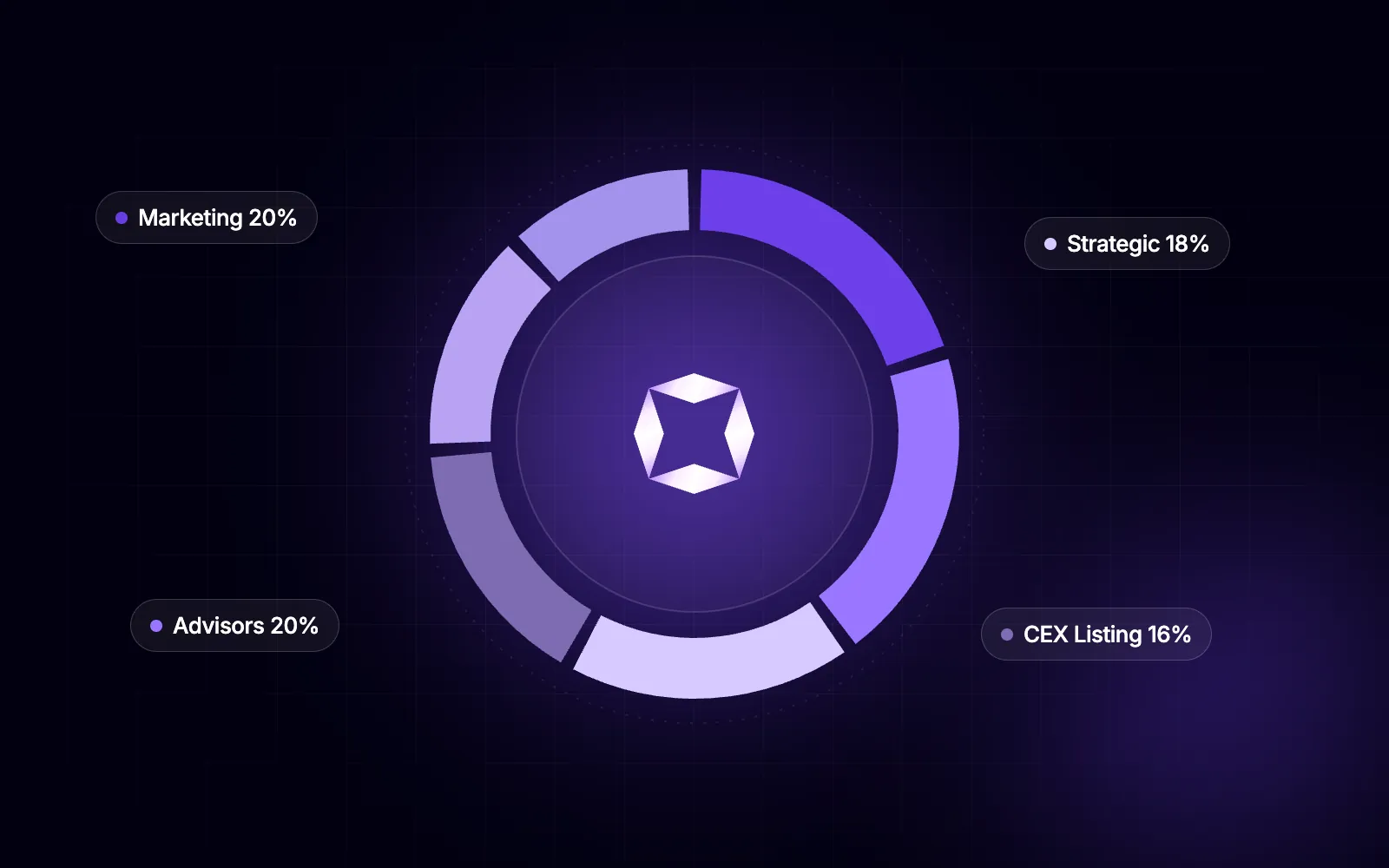
How the supply is divided
- Marketing, 20%: community campaigns, education and partner programs, released monthly over 24 months.
- Advisors, 20%: the team and advisors who build the protocol, with a 12-month cliff and then 36 months of monthly releases.
- Strategic, 18%: a treasury reserve for development, audits and long-term partnerships, with a 6-month cliff and then 18 months of releases.
- CEX Listing, 16%: liquidity that keeps trading pairs deep on centralized exchanges, released over 6 months.
- Ecosystem, 14%: grants, integrations and the rewards paid to people who stake ATL, released over 48 months.
- Seed, 12%: early supporters, locked for 12 months and then released monthly over 24 months.
The presale
The ATL presale runs in three stages, priced at $0.018, $0.024 and $0.030 per token, with a $6.0M hard cap. Tokens bought in the presale can be claimed at the token generation event in December 2026, when ATL lists on its first decentralized exchange at $0.040. Tier-1 exchange listings and a bridge to six networks follow in 2027.
Vesting and unlock schedule
Large unlocks can flood the market and hurt holders, so every allocation outside the liquidity pool follows a gradual schedule. Team and advisor tokens have a 12-month cliff, which means nothing unlocks for the first year, followed by monthly releases over the next three years.
We would rather earn trust slowly than spend it all on launch day. Every unlock date is public and every wallet is visible on-chain.
We publish the full unlock calendar and the addresses of every allocation wallet, so anyone can verify that tokens move only when the schedule says they should.
What ATL is used for
A token needs real uses to hold value over time. ATL has three:
Lower trading fees
Pay your trading fees in ATL and you get 20% off on every plan, so a Starter fee of 0.25% drops to 0.20%.
Staking and governance
Staked ATL earns weekly rewards from the Ecosystem pool, up to 12.4% APY in the 90-day pool, and every staked ATL is one vote on proposals, from new listings to changes in fee structure.
Ecosystem access
Holders get access to more than 40 partner apps, early launchpad slots and premium analytics such as portfolio insights.
Burn and buyback
Each quarter, a portion of platform fees is used to buy ATL on the open market and permanently remove it from circulation. Over time this offsets part of the new supply entering through unlocks and staking rewards.
The size of each burn depends on actual platform revenue, not on a fixed promise, and every burn transaction is published with its on-chain record. If trading volume rises, more ATL is removed; if it falls, the burn shrinks. This keeps the mechanism honest and tied to real usage.
Governance in practice
Proposals can be submitted by any wallet that has staked ATL for at least 30 days. Each proposal runs through a discussion period, then a seven-day vote. Results are binding for changes within the protocol's parameters, such as fee discounts or staking pool sizes, and advisory for larger strategic decisions.
Why we designed it this way
Every choice in this model points in one direction: rewarding people who use the platform and stay for the long term. Fixed supply, slow vesting, public wallets and real utility are not marketing points; they are commitments we expect to be held to.
To learn more about the people and the principles behind Aethel, visit our About page.
Crypto assets are volatile and you can lose money. Prices, staking rates and presale terms can change and are never guaranteed, and nothing here is financial advice.